Sunday Reset Outfit vs. Loungewear: What's Actually Different

Quick Answer: The core difference between a Sunday reset outfit and loungewear is structure, not comfort level — a reset outfit uses slightly fitted or waist-defined pieces that keep you feeling capable and upright, while true loungewear (soft joggers, oversized tees, no waistband definition) subtly cues your brain toward rest mode instead of task mode.
Both outfits can use nearly identical fabrics and be equally comfortable — the difference that actually matters is psychological, not material, and it shows up in how much you get done in either one.

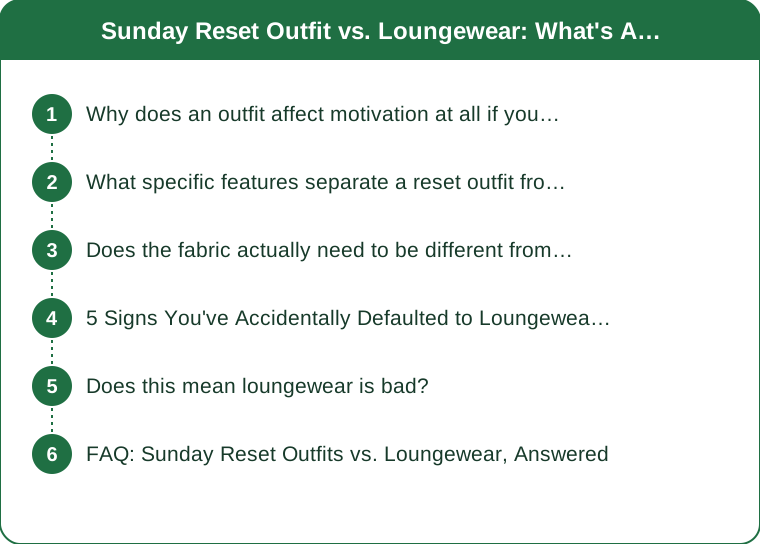
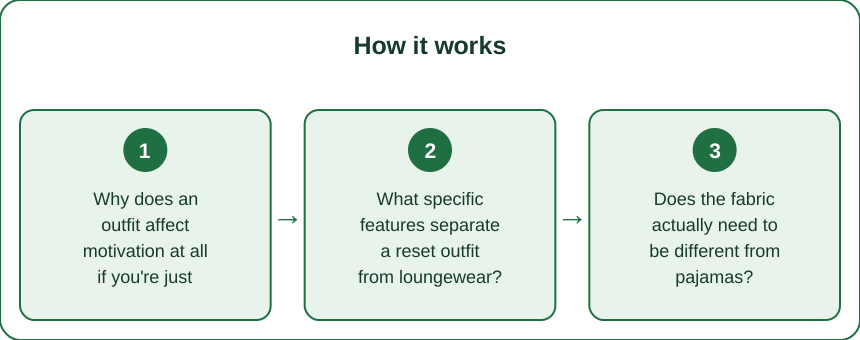
Why does an outfit affect motivation at all if you’re just home alone?
Clothing carries what researchers call “enclothed cognition” effects — the physical and symbolic properties of what you’re wearing measurably shift focus and behavior, even with no one else around to see it. A completely shapeless, soft outfit signals “off duty” to your own brain, which is exactly the right signal for actual rest, but works against you on a day meant for light tasks and resetting your space.
This isn’t about looking presentable for anyone — it’s a self-directed signal, which is why the effect holds up even alone at home with the blinds closed.
What specific features separate a reset outfit from loungewear?
A defined waistband (even a soft elastic one, as long as it sits at your actual waist) is the single biggest differentiator — it maintains a sense of your own shape, versus a low-slung or fully loose waistband that removes that structure entirely. A slightly fitted or cropped top instead of an oversized one does similar work up top.
Closed-toe, structured slippers or clean sneakers instead of bare feet or slide sandals finish the difference — footwear is a surprisingly strong cue for “task mode” versus “rest mode” even indoors.
Does the fabric actually need to be different from pajamas?
Not necessarily — the same soft, breathable knit fabric works for both; it’s the cut and fit that carry the signal, not the material itself. A structured knit set (fitted rib top, higher-rise legging or straight pant) can use fabric just as soft as pajamas while still reading as “dressed” to your own brain because of how it’s shaped.

5 Signs You’ve Accidentally Defaulted to Loungewear Instead of a Reset Outfit
1. You’ve checked the time and lost track of it more than once — a sign your brain has shifted into low-focus mode. 2. Your waistband has zero definition anywhere — fully loose from hip to ankle. 3. You’re still in the outfit you slept in, even if it’s technically “daywear.” 4. Your feet are bare or in slides rather than any closed, structured shoe. 5. Your task list has stalled — this is more a symptom than a cause, but it’s the clearest real-world signal the outfit shift already happened.
Does this mean loungewear is bad?
Not at all — loungewear is doing exactly its job when the goal is genuine rest. The issue is only when a day is meant for light resetting tasks (laundry, meal prep, tidying) but the outfit is accidentally cueing full rest mode instead, leading to a Sunday that feels both unproductive and somehow not fully restful either.
FAQ: Sunday Reset Outfits vs. Loungewear, Answered
Can I switch outfits partway through a Sunday if my plans change?
Yes, and it’s a genuinely useful trick — changing from loungewear into a reset outfit partway through the day can restart motivation for an afternoon of tasks even if the morning was pure rest.
Is this just about looking nice, or is the comfort level actually the same?
Comfort level is meant to be equivalent — a well-chosen reset outfit shouldn’t feel more restrictive than loungewear, just more structured in specific, deliberate ways.
What if I genuinely don’t feel a difference between the two?
Some people are less sensitive to this effect than others — if outfit choice doesn’t change your focus, there’s no need to force the distinction; use whatever gets tasks done for you specifically.
TL;DR:
- The difference between reset outfits and loungewear is structure (waistband, fit, footwear), not comfort or fabric
- A defined waist and closed shoes are the two strongest cues that shift your brain from rest mode to task mode
- Loungewear isn’t wrong — it’s just calibrated for actual rest, not light tasks
- Switching outfits partway through a stalled Sunday can genuinely restart motivation
The outfit doesn’t need to be more uncomfortable to work harder for you — it just needs a little more shape.
Keep Reading
This article is for general informational and styling purposes only. Fit, sizing, and product availability may vary.