Why Your Sunday Reset Needs a Shorter List Once the Evenings Get Dark

Quick Answer: A Sunday reset built in summer usually assumes daylight until nine, which quietly gives it three or four more usable hours than an autumn Sunday has. The same list in October runs into the dark, gets abandoned two-thirds through, and turns a routine that used to feel good into a weekly failure. Cut the list to what fits before it gets dark, move anything requiring energy to the morning, and let the dark hours hold only the low-effort, pleasant items.
The reset used to end with you feeling ahead of the week.
Now it ends at nine at night with three things unticked and a vague sense of having lost the whole day.

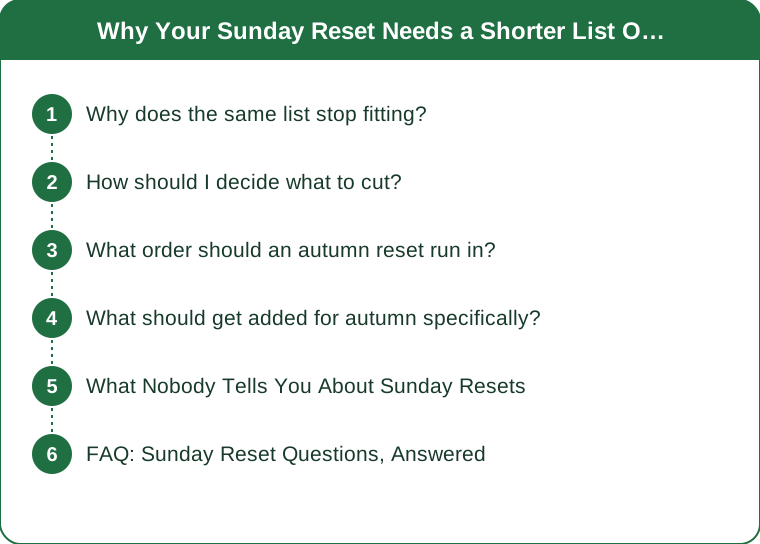
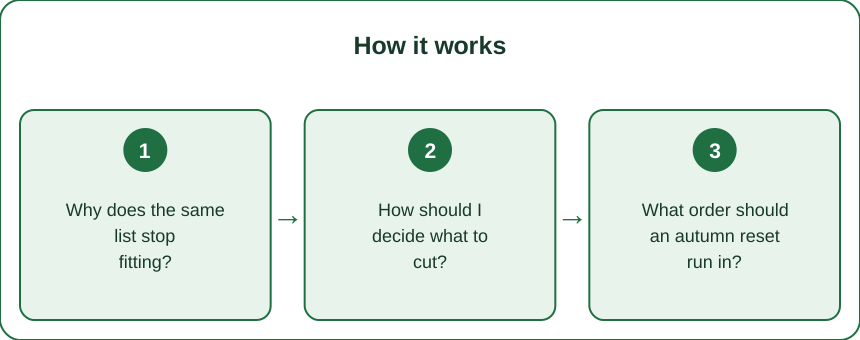
Why does the same list stop fitting?
Because it was calibrated against summer daylight without anyone writing that down. A June Sunday has usable light until nine; an October one is dark by six.
Energy tracks light more than clock time for most people, so the same tasks feel heavier at four in the dark than at four in bright light.
Autumn Sundays acquire new tasks - more cooking, more indoor tidying, more admin - while the list from summer stays intact underneath.
And the reset expands to fill whatever it is given, which means a list that was ambitious in June is genuinely unachievable in October.
The failure feels personal because the list did not change, so the only visible variable is you.
But nothing about your capacity changed - the container did.
How should I decide what to cut?
Start by listing what you actually do, not what you intend to do, since most reset lists contain two or three items that have not been done since spring.
Keep the items that reduce Monday friction: clothes ready, food decided, calendar checked. These are the ones with an actual return.
Cut the items that are maintenance disguised as reset - deep cleaning, reorganising, sorting - and move them to a monthly slot instead of a weekly one.
Cut anything that requires leaving the house after four, which in autumn is a much bigger ask than it was in July.
Halve the list rather than trimming it, because a slightly shorter list runs into the same wall a fortnight later.
And keep one item that is purely enjoyable, which is what makes the routine something you return to rather than something you owe.
What order should an autumn reset run in?
Anything requiring energy or leaving the house goes in the morning, which is when both light and motivation are highest.
Errands and outdoor tasks before two, since the light drops off faster than you expect from mid-September.
Cooking and food prep in the afternoon, which uses the kitchen while it is still bright and produces the highest Monday return of anything on the list.
Admin, planning and calendar review in the early evening under lamplight, since these are indifferent to daylight and pleasant to do warm.
The dark hours hold only low-effort items: laying out clothes, tidying surfaces, reading the week ahead.
And finish deliberately rather than fading out, because a reset with a defined end feels complete and one that trails off feels abandoned.

What should get added for autumn specifically?
A weekly look at the calendar for darkness conflicts - which evening commitments now involve travelling home in the dark, and whether that changes what you agree to.
One food item prepared ahead, since cooking from scratch on a dark Tuesday is the first thing to collapse and the most expensive to replace.
A five-minute lighting pass: lamps on timers, a bulb replaced, a corner that is dim fixed. It is trivial and it changes how the whole week feels indoors.
A layer check. Knowing where your coat, boots and gloves are before the first genuinely cold morning removes a recurring weekday scramble.
Something to look forward to mid-week, which matters more in autumn than in summer and takes two minutes to arrange.
And a short outdoor block, deliberately scheduled, because daylight exposure drops sharply in autumn and Sunday is the easiest day to protect it.
What Nobody Tells You About Sunday Resets
Most reset lists are two lists in a trench coat. There is a genuine weekly reset - food, clothes, calendar - and a rolling backlog of household maintenance that has attached itself. Separating them makes both manageable, and the maintenance one belongs on a monthly cadence.
The reset is often the thing that ruins Sunday. A routine designed to reduce Monday anxiety frequently consumes the entire day it is supposed to protect, which is a bad trade nobody audits.
Sunday evening dread is not caused by an incomplete list, and no amount of extra ticking fixes it. Finishing earlier and leaving two hours of genuinely unstructured evening does more than finishing everything.
Food preparation has by far the highest return of any reset item. One prepared component - a grain, a sauce, a batch of something - saves more weekday time and decision energy than every organisational task combined.
The list gets longer every time it fails. People respond to an abandoned reset by adding structure, which makes the next one heavier and more likely to fail. The correct response is almost always to cut.
And doing it on Saturday is allowed. Nothing about the routine requires Sunday, and moving it to Saturday morning gives you a full Sunday and a better-lit reset. The name is not a rule.
FAQ: Sunday Reset Questions, Answered
How long should a Sunday reset take?
Ninety minutes to two hours for the weekly items. If it is consuming a whole day, it has absorbed maintenance tasks that belong on a different cadence.
What should never be cut from the list?
Food decisions and clothes for Monday. Those two produce most of the reduced weekday friction that makes the routine worth doing at all.
Should I move the reset to Saturday?
Many people find it works better - Saturday morning has more light and more energy, and it leaves Sunday genuinely free. There is nothing sacred about Sunday.
How do I stop the list from growing?
Cap it at a fixed number of items. Adding something means removing something, which forces the maintenance tasks onto a monthly list where they belong.
Why does the reset feel worse in autumn even when I finish it?
Mostly reduced daylight exposure and the routine running into dark hours. Moving the effortful parts into the morning changes how it feels more than changing the content does.
Is meal prep worth the time it takes?
One or two prepared components is almost always worth it. Full week-long meal prep frequently is not, and is one of the most commonly abandoned reset items.
What if I miss a week?
Nothing happens. A reset is a convenience routine, not an obligation, and treating a missed week as a failure is what turns a useful habit into a source of guilt.
TL;DR:
- A summer reset list assumes three or four more usable hours than an autumn Sunday actually has.
- Halve the list rather than trimming it, and move household maintenance to a monthly cadence.
- Effortful and outdoor tasks in the morning; dark hours hold only low-effort, pleasant items.
- Food preparation has by far the highest weekday return of any reset task.
- Add a lighting pass, a layer check and a protected outdoor block for autumn specifically.
- Saturday is allowed - the name is not a rule.
The list did not get harder. The day got shorter.
Keep Reading
This article is for general informational and styling purposes only. Fit, sizing, and product availability may vary.