Why Your Sunday Reset Should Start on Saturday Night

Quick Answer: A Sunday reset fails when the first hour is spent on visible mess that steals your momentum. Moving three specific categories to Saturday night — surfaces, laundry start, and one decision about the week — means Sunday begins in an already-calm room. Twenty minutes on Saturday reliably saves an hour or more on Sunday, because you are removing setup time rather than adding work.
You wake up on Sunday with a plan.
You walk into the kitchen and the plan meets last night’s dishes.
By the time you have dealt with that, the good part of the morning is gone.

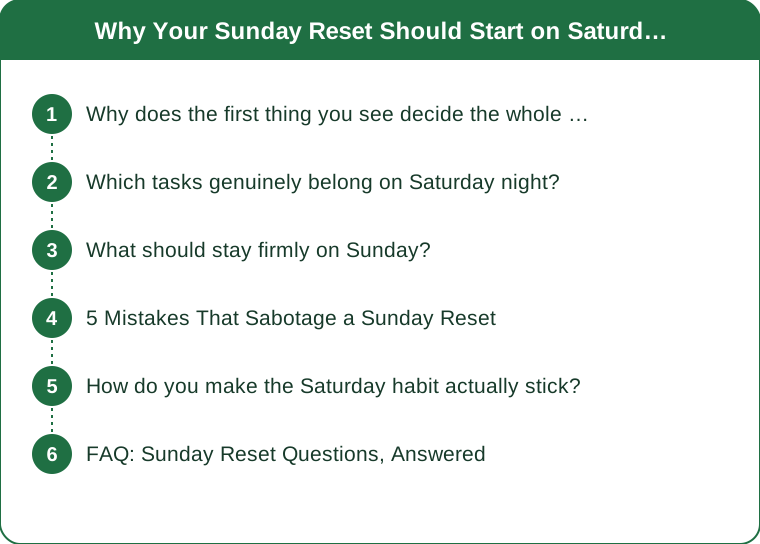
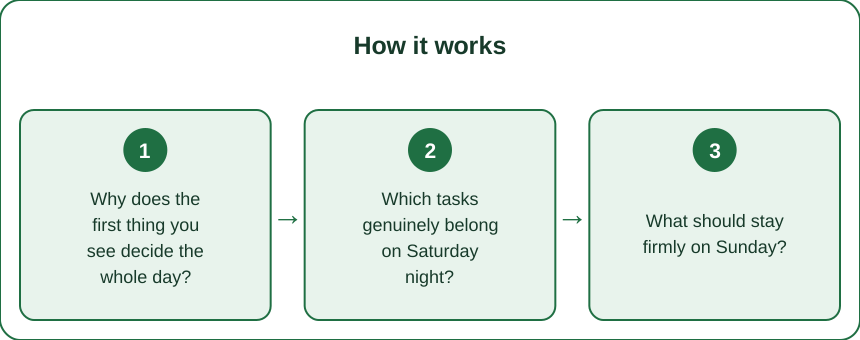
Why does the first thing you see decide the whole day?
Because momentum on an unstructured day is fragile, and the first task sets its direction.
A Sunday reset is voluntary work with no external deadline. That means it depends almost entirely on momentum, and momentum is built by starting with something that has a visible, immediate result. Wiping a clear counter is satisfying. Excavating a counter buried in last night’s plates is not — it feels like remedial work rather than progress.
There is also a decision-cost issue. Walking into a messy room requires you to decide where to start, and that decision happens before you have any momentum to spend on it. Walking into a mostly-clear room lets you begin with whatever you had planned.
So the point of Saturday night is not to do more cleaning. It is to remove the decision and the remedial work from the front of Sunday, where they cost the most.
Which tasks genuinely belong on Saturday night?
Three categories, and they share a common property: they take very little time and they unblock everything else.
Surfaces. Kitchen counter, dining table, coffee table, and whatever your household’s default dumping ground is. Not deep cleaning — just clearing. Ten minutes covers this in most homes.
A laundry start. Loading and starting one machine on Saturday night means Sunday morning begins with something to hang up rather than something to begin. Laundry is the classic bottleneck task, because everything downstream waits on the machine.
One decision about the week. Not a full plan. One decision — what is for dinner on the two busiest nights, or which day the difficult errand happens. Decisions made when you are relaxed are better than decisions made when you are mid-reset, and it stops Sunday from becoming a planning session.
That is the whole Saturday list. Twenty minutes, three items, and none of them are demanding.
What should stay firmly on Sunday?
Anything with a satisfying visible result, and anything that needs daylight.
Hanging and folding laundry is good Sunday work — it is calm, it has a clear end point, and it benefits from a warm dry room.
The fridge clear-out and the food shop need daylight and energy. They are also the tasks with the biggest payoff for the week ahead, so they deserve your best hours rather than your last ones.
Anything involving other people. Saturday night is for the tasks you can do quietly and alone. Sunday is when a household can share work.
Anything that makes noise. Vacuuming, blending, moving furniture — all Sunday, unless you have unusually tolerant neighbours.
The division is essentially: Saturday removes obstacles, Sunday does the work.

5 Mistakes That Sabotage a Sunday Reset
1. Starting with the hardest room. People often begin with the room that bothers them most, which is usually the one that will take ninety minutes. Start with the room you use first in the morning instead; the win carries you.
2. Treating the reset as unlimited. A reset without an end time expands to fill the whole day and leaves you feeling like the weekend disappeared. Give it a hard stop — two hours, say — and let the list adjust to the time rather than the other way around.
3. Adding a task every week and never removing one. Reset lists accumulate. Once a season, cross off the three things you have skipped most often. If you never do them, they are not part of the routine, they are just guilt on paper.
4. Planning the week in too much detail. An hour of elaborate planning on Sunday routinely produces a plan that Tuesday ignores. Decide the two or three things that are genuinely fixed and leave the rest loose.
5. Scheduling it for the same time regardless of season. As evenings get darker through September and October, an afternoon reset ends in the dark and feels much longer. Shift it earlier as the light changes rather than defending the same slot all year.
How do you make the Saturday habit actually stick?
Attach it to something you already do, and keep it genuinely small.
The reliable anchor is the end of the evening meal. Not a separate time slot, not an alarm — simply that the twenty minutes begins when dinner is finished. Habits attached to existing habits survive far better than habits attached to clock times.
Keep the list written down and keep it short enough to be visible in one glance. Three lines on a card by the kettle beats an app you have to open. The point is not the tracking; it is that you do not have to remember what the list is when you are tired.
And give yourself an explicit permission clause: on the weeks where Saturday night is out — you were out, you were away, it was simply not that kind of evening — skip it entirely without adjusting Sunday. A routine that only works when the week cooperates is not a routine. One skipped Saturday costs you an hour on one Sunday, which is a perfectly survivable price.
FAQ: Sunday Reset Questions, Answered
How long should a Sunday reset actually take?
For most households, 90 minutes to two hours including laundry handling and a food plan. If yours reliably takes four hours, the list has grown beyond a reset into a deep clean and is worth splitting.
What if I work weekends?
The principle is about the night before your reset day, not about Saturday specifically. Move both anchors to whichever pair of days your week actually has.
Should the whole household do it together?
Sunday tasks, yes. The Saturday night twenty minutes works best as a single person quietly clearing surfaces — it is too small to be worth coordinating, and coordination is what makes small tasks feel large.
TL;DR:
- Sunday resets fail at the start, when visible mess absorbs your best momentum.
- Move three things to Saturday night: clear surfaces, start one load of laundry, make one decision about the week.
- Keep daylight tasks, noisy tasks and shared tasks on Sunday, and give the reset a hard stop.
- Shift the whole routine earlier as autumn evenings darken rather than defending the same time slot.
Twenty minutes the night before does not sound like a system. It behaves like one, mostly because it removes the part of Sunday that was never really about cleaning.
Keep Reading
This article is for general informational and styling purposes only. Fit, sizing, and product availability may vary.