Why a Tired Sunday Reset Beats a Perfect One You Keep Postponing

Quick Answer: A 20-minute reset done every week keeps your home and schedule within recovery distance of normal. A two-hour reset done every third week lets things drift far enough that the reset itself becomes a dreaded project. The value is in the frequency, not the depth — so on a tired Sunday, do the short version rather than postponing to a Sunday when you will supposedly have more energy.
It is 7:40pm, you have done nothing, and the version of the reset in your head takes ninety minutes.
So you skip it. That is the actual failure — not the mess.

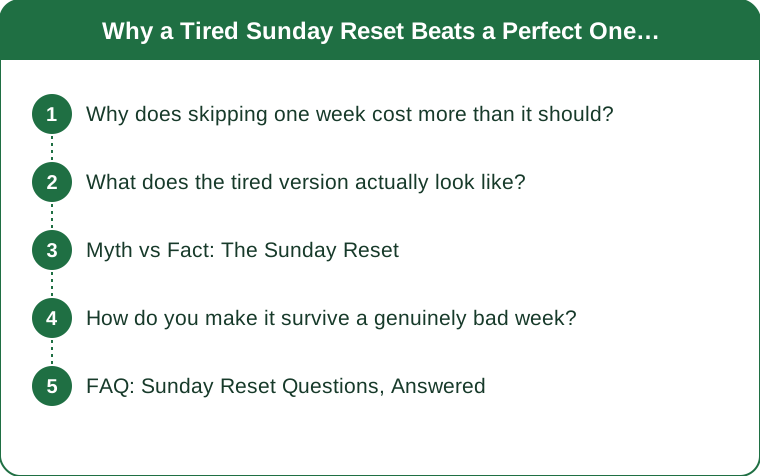
Why does skipping one week cost more than it should?
Because household entropy is not linear, and the reset is not really about the tasks.
One skipped week does not leave you with one week of mess. It leaves you with one week of mess plus the friction of an environment that no longer supports the routine. Laundry that did not get folded means the basket is occupied, which means the next load has nowhere to go, which means clothes live on a chair, which means the chair is not available, and so on.
Each skipped item removes the surface the next item needed.
The same thing happens with the planning half. If you did not look at the week, Monday morning becomes a discovery process. You find out about the appointment at 8:15am, and every decision after that is made under time pressure. That is not a lost twenty minutes; it is a week that runs a half-step behind.
There is also the psychological cost, which is the one people underestimate. A routine you have kept is easy to keep; a routine you have broken has to be restarted. Restarting requires a decision, and decisions on a Sunday evening in a messy flat are made by a tired person who wants to watch something instead. This is the mechanism behind a reset that quietly disappears in September and does not come back until January.
What does the tired version actually look like?
Short, fixed, and the same every time so you do not have to decide anything.
Fifteen to twenty minutes, four things, in this order:
- Reset the flat surfaces. Kitchen counter, dining table, the chair. Not cleaning — clearing. Things go where they live or into one basket to deal with later. Six minutes.
- Start one load of laundry. Starting it is the task. Folding is optional. A machine running while you sleep is progress that requires no energy.
- Look at the week in one place. Calendar, five minutes, out loud if it helps. You are looking for exactly two things: what happens that you are not ready for, and what has to leave the house with you on which day.
- Set out tomorrow morning. Clothes, bag, the thing you will forget. Two minutes on Sunday buys back ten on Monday.
That is the whole thing. Notice what is not on the list: deep cleaning, meal prep, inbox zero, the drawer, the bathroom, the plan for the month. Those belong to the ambitious version, and the ambitious version is what has been killing your streak.
If you have more energy, do more. But the twenty-minute core is the part that must not be negotiable, because it is the part that keeps the following week inside recovery distance.

Myth vs Fact: The Sunday Reset
Myth: a reset should leave the house properly clean. Fact: a reset is a maintenance routine, not a cleaning session. Conflating the two is the single most common reason people abandon it — cleaning is a two-hour job, and nobody consistently volunteers two hours on a Sunday evening.
Myth: if you cannot do it properly, it is not worth doing. Fact: this is backwards for anything maintenance-shaped. Partial maintenance keeps a system inside its normal operating range. Skipped maintenance lets it leave that range, and returning costs far more than staying.
Myth: it should feel restorative. Fact: sometimes it does, often it does not, and expecting it to feel good is what makes an ordinary tired Sunday feel like a failure. It is closer to brushing your teeth than to self-care, and framing it that way makes it much easier to keep.
Myth: doing it earlier in the day is better. Fact: earlier is easier, but the timing that survives is the one attached to something you already do without fail. If your Sunday evening always ends with the same show, the reset that happens before that show will outlast the one scheduled for 11am.
Myth: you need a system. Fact: you need a list short enough to do while tired. Most reset systems fail because they were designed by a rested person on a good week for a tired person on a bad one, and those are different people with different capacities.
How do you make it survive a genuinely bad week?
By pre-deciding what the minimum is, before you need it.
Write the five-minute version down now. Not the twenty-minute version — the emergency one. For most people it is: clear the kitchen counter, start the laundry, look at tomorrow only. Three things, five minutes, done standing up.
Detach it from a time of day. The reset that survives is the reset attached to a trigger you cannot skip, not a clock you can ignore. After dinner. Before the shower. When the dishwasher goes on.
Let the week absorb the overflow. If the twenty-minute version leaves things undone, the undone parts go into a specific slot — Tuesday evening, ten minutes — rather than into next Sunday, where they will make next Sunday’s version too big to start.
Do not restart from zero. After a skipped week, the instinct is to do the big catch-up version, which is exactly the version you will avoid. Do the five-minute one instead. The streak matters more than the state of the flat.
Stop measuring it by how the room looks. The right measure is whether Monday morning was calm. A tidy flat and a chaotic Monday means you reset the wrong things.
And for the specific season you are in: the first few weeks of the school year and the first few weeks of a schedule change are precisely when the reset is most valuable and least likely to happen. That is not a coincidence, and it is worth deliberately shrinking the routine during those weeks rather than hoping to keep the full one.
FAQ: Sunday Reset Questions, Answered
Is Sunday the wrong day for this?
For many people, yes. Sunday evening carries the anticipation of Monday, which is exactly when motivation is lowest and dread is highest. Saturday morning or Friday evening both work better for a lot of households, and the day matters far less than the consistency. If your reset keeps failing on Sundays specifically, move it before concluding you cannot keep one.
What if I live with people who do not participate?
Then reset your own dependencies and shared surfaces only, and stop counting the rest as your job. The most common way a household reset collapses is one person quietly expanding it into a whole-house tidy for everybody, resenting it, and stopping. Twenty minutes of your own load is sustainable; an unacknowledged hour of everybody’s is not.
How long before it feels automatic?
Usually six to eight repetitions, and considerably longer if the routine changes size each week. Keeping the same short list every time is what builds the automaticity, which is another argument for the tired version — a routine that is identical every week becomes a habit, while one that expands and contracts stays a decision.
TL;DR:
- Frequency beats thoroughness — a 20-minute weekly reset keeps things inside recovery distance in a way a rare deep reset never does.
- The tired version is four things: clear flat surfaces, start one load of laundry, look at the week, set out tomorrow morning.
- Skipping compounds, because each undone task removes the surface the next one needed, and a broken routine has to be restarted rather than continued.
- Pre-write a five-minute emergency version and attach the whole thing to a trigger, not a clock.
- Judge it by how calm Monday morning was, not by how the room looks.
The reset is maintenance, not achievement. Once you stop expecting it to transform the week and start treating it as the thing that keeps the week from getting away from you, the bad-energy Sundays stop being a threat to the habit — they become the exact situation it was designed for.
Keep Reading
This article is for general informational and styling purposes only. Fit, sizing, and product availability may vary.