The One Sunday Reset Outfit Detail That Actually Signals 'Stop Scrolling, Start Tasks'

Quick Answer: A fully loose, pajama-like outfit sends a subconscious rest signal that makes scrolling feel natural, while a Sunday reset outfit with one structured detail — a fitted waistband, a real shoe, a layered top — sends a task-ready signal instead, which behavioral research on clothing and mindset suggests genuinely affects follow-through.
The intention was a productive reset Sunday. Two hours of scrolling later in full pajama softness, the intention and the outfit turned out to be working against each other.

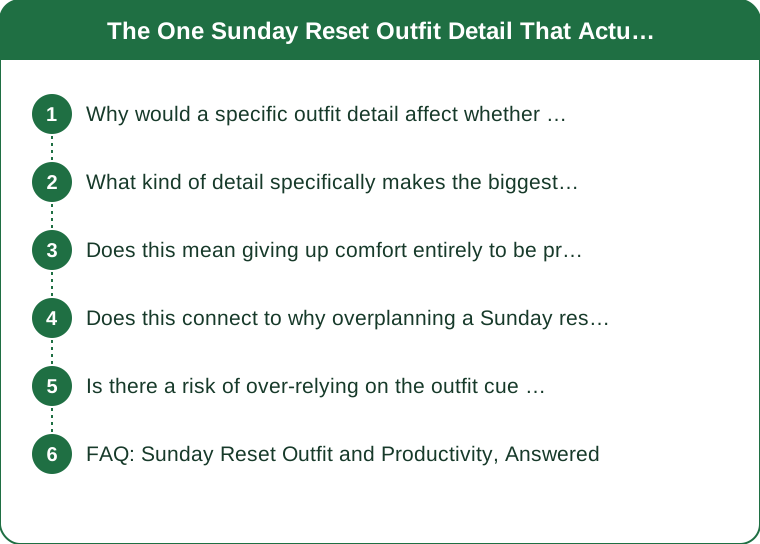
Why would a specific outfit detail affect whether tasks actually get done?
This connects to the enclothed cognition research also relevant elsewhere in reset-day and staycation styling — clothing carries psychological association, and fully loose, sleep-associated clothing can subconsciously cue rest-mode behavior, including passive activities like scrolling, while clothing with even one structured element cues a more active, task-ready mindset instead.
What kind of detail specifically makes the biggest difference?
A fitted waistband instead of a fully elastic, shapeless one, a real (if casual) shoe instead of bare feet or slippers, or a layered top instead of a single oversized sleep shirt each individually shift the outfit’s signal from purely restful toward active-but-comfortable, without sacrificing genuine comfort in the process.
Does this mean giving up comfort entirely to be productive on a reset day?
No — the goal isn’t trading comfort for structure, it’s finding the specific comfortable pieces that still carry a task-ready signal, which is a meaningfully different goal than either full loungewear or a fully polished outfit; comfort and task-readiness aren’t actually opposed, they just require slightly more intentional piece selection.

Does this connect to why overplanning a Sunday reset routine tends to backfire?
Indirectly, yes — an outfit detail is a low-effort, low-decision-fatigue way to nudge behavior compared to a heavily scheduled, overplanned task list, which other Sunday reset guidance already flags as a common mistake; a small styling cue works with less friction than a rigid schedule that’s easy to abandon by midday.
Is there a risk of over-relying on the outfit cue instead of actual planning?
Some baseline task awareness (even a short mental or written list) still matters — the outfit detail is a supporting nudge that makes follow-through easier, not a replacement for having any plan at all, so it works best paired with at least minimal task intention rather than as a standalone fix.
FAQ: Sunday Reset Outfit and Productivity, Answered
Does this effect work the same way for everyone, or does it vary by person?
Enclothed cognition effects vary in strength by individual, but the general direction — structured clothing nudging toward active mindset — is consistently observed across most studied populations.
Should the task-ready outfit be worn all day, or just during the productive block?
Just during the intended active block is enough; switching back to full loungewear afterward for genuine rest doesn’t undo the earlier benefit.
Does footwear indoors actually matter, or is that detail overstated?
It’s one of the more commonly cited cues in this research area — putting on real shoes indoors is a small, low-cost action that reliably correlates with more active behavior following it.
TL;DR:
- Fully loose, sleep-associated clothing can subconsciously cue passive, scrolling-prone behavior
- One structured detail — waistband, shoe, layered top — shifts the signal toward task-ready
- This isn’t about sacrificing comfort, just choosing comfortable pieces with one structured element
- A styling cue creates less friction than an overplanned, easily-abandoned task schedule
- Pairing the outfit detail with at least minimal task intention works better than the outfit alone
One deliberate detail does more behavioral work than the whole outfit’s comfort level combined.
Keep Reading
This article is for general informational and styling purposes only. Fit, sizing, and product availability may vary.