Why a Sunday Reset Works Better in Two Short Blocks Than One Long One

Quick Answer: A single long reset block fails on two counts: it requires a chunk of time most Sundays do not contain, and decision quality declines steeply after about 45 minutes of continuous tasks. Two 40 to 50 minute blocks with a real break between them get through more, feel better, and survive a busy Sunday. Split them: one block on the physical space, one on the week ahead.
The four-hour version is the one you skip.
Two forty-five minute blocks get more done.
And you do not spend Sunday evening exhausted.

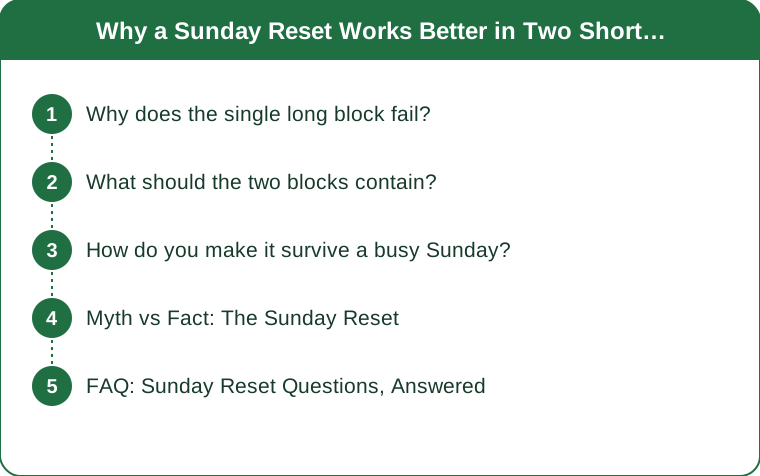
Why does the single long block fail?
Three reasons, and the first is scheduling rather than psychology.
It needs a resource most Sundays do not have. A four-hour uninterrupted block is a rare thing. A routine requiring it will run perhaps two Sundays a month, and then stop.
Decision quality declines with sustained task-switching. A reset is a long sequence of small decisions — keep or discard, now or later, where does this go. After 45 minutes or so, those decisions get worse and slower, and you start making the kind of choices that create a mess for next week.
Physical fatigue arrives sooner than expected. Tidying, laundry and cleaning are more physically demanding than they look. The last hour of a four-hour reset is usually low-quality work.
The all-or-nothing framing kills it. If the reset is a four-hour project, a Sunday with 90 minutes reads as not enough, and nothing happens at all.
And it produces a bad Sunday evening. Finishing a marathon reset at 6pm leaves you tired going into Monday, which is the exact opposite of what a reset is supposed to achieve.
The evidence people already have: the weeks the reset actually happens are usually the weeks it was shorter.
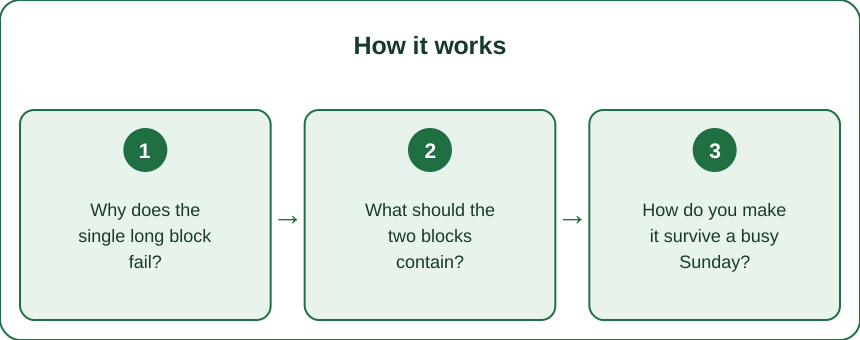
What should the two blocks contain?
Split by type of thinking, not by room.
Block one: the physical space. Laundry started, kitchen reset, surfaces cleared, floors done, bins out. Physical, low-decision work that benefits from momentum.
Block two: the week ahead. Calendar checked, meals planned, shopping list made, admin dealt with, bag packed for Monday. Cognitive work that needs a fresh head.
Do them in that order. Physical work first is genuinely easier when you are less warmed up, and the planning block benefits from a tidy space to think in.
Put a real break between them. 30 to 60 minutes minimum — a walk, lunch, sitting down properly. The break is not a pause in the reset; it is what makes the second block work.
Cap each at 50 minutes. Set a timer. Whatever is unfinished rolls to next week, and this is what stops the reset expanding to fill the day.
Start the laundry before block one begins. Machine time runs in parallel with everything else, which is the single best sequencing decision available.

How do you make it survive a busy Sunday?
Six adjustments for when Sunday is not actually free.
Define a 20-minute minimum version in advance. Kitchen reset, one load of laundry, look at the week’s calendar. Write it down now, while you have capacity to decide.
Move one block to Saturday or Friday evening. The blocks are independent — the planning block works perfectly well on a Friday evening and arguably better.
Do the planning block first when time is short. Knowing what the week holds does more for a stressful week than a clean kitchen does.
Attach the blocks to fixed events. After breakfast, after lunch. Free-floating intentions on a Sunday get pushed until the day is gone.
Keep a running list during the week. Anything that needs the reset goes on a list as you notice it, so the block starts with a plan rather than with ten minutes of deciding what to do.
Let some weeks be minimum-version weeks. A reset that only counts when it is complete is a reset you will abandon by November.
Seasonal note: the transitional season adds one-off tasks — swapping wardrobes, checking heating, putting away summer things. Rather than letting these blow up a normal Sunday, add one seasonal task per week to block one across September and October. It spreads a whole day’s work across six weeks without anyone noticing.
Myth vs Fact: The Sunday Reset
Myth: a proper reset takes a whole afternoon. Fact: two 45-minute blocks get through more than four continuous hours, because decision quality holds.
Myth: it has to be Sunday. Fact: it needs to be before the week starts. Saturday, Friday evening, or split across both works identically.
Myth: you should do the whole house. Fact: the kitchen and the week’s plan account for most of the benefit. The rest is optional and the first thing to drop.
Myth: a reset is about cleaning. Fact: the planning half is what changes the week. A spotless house with no plan for Wednesday is the less useful outcome of the two.
Myth: if you miss a week the routine is broken. Fact: missing one week is normal. The routines that survive are the ones with a defined minimum version, not the ones with perfect records.
Myth: it should feel restorative. Fact: it is work, and it produces a restorative week. Expecting the reset itself to feel like rest is how people end up resenting it.
Myth: more preparation is always better. Fact: over-planning a week that then changes is wasted effort. Plan the fixed points and the meals, and leave the rest loose.
FAQ: Sunday Reset Questions, Answered
How long should each block be?
40 to 50 minutes, with a timer, and a 30 to 60 minute real break between them.
What goes in which block?
Block one: physical space — laundry, kitchen, surfaces, floors. Block two: the week ahead — calendar, meals, shopping, admin.
What if I only have 20 minutes?
Kitchen reset, one load of laundry, look at the week’s calendar. Define that minimum version in advance so you shrink rather than skip.
Does it have to be Sunday?
No. It has to happen before the week starts. Friday evening plus Saturday morning works just as well.
Which block matters more?
The planning one, if you have to choose. Knowing what the week holds beats a clean kitchen for a stressful week.
How do I stop it expanding to fill the day?
A timer, and a rule that unfinished items roll to next week. Without a cap it will absorb the whole Sunday.
How do I handle seasonal jobs?
One per week added to block one, across several weeks. Spreading them prevents a single Sunday from becoming an all-day project.
TL;DR:
- One long block requires time most Sundays do not have, and decision quality drops after about 45 minutes.
- Two 40 to 50 minute blocks with a real break between them get through more.
- Block one: physical space. Block two: the week ahead. In that order.
- Define a 20-minute minimum version in advance so busy weeks shrink it rather than skip it.
- Add one seasonal task per week instead of losing a whole Sunday to the wardrobe swap.
This Sunday, set a 45-minute timer, do the physical block, then stop and have lunch. The second block will be better for it.
Keep Reading
This article is for general informational and styling purposes only. Fit, sizing, and product availability may vary.